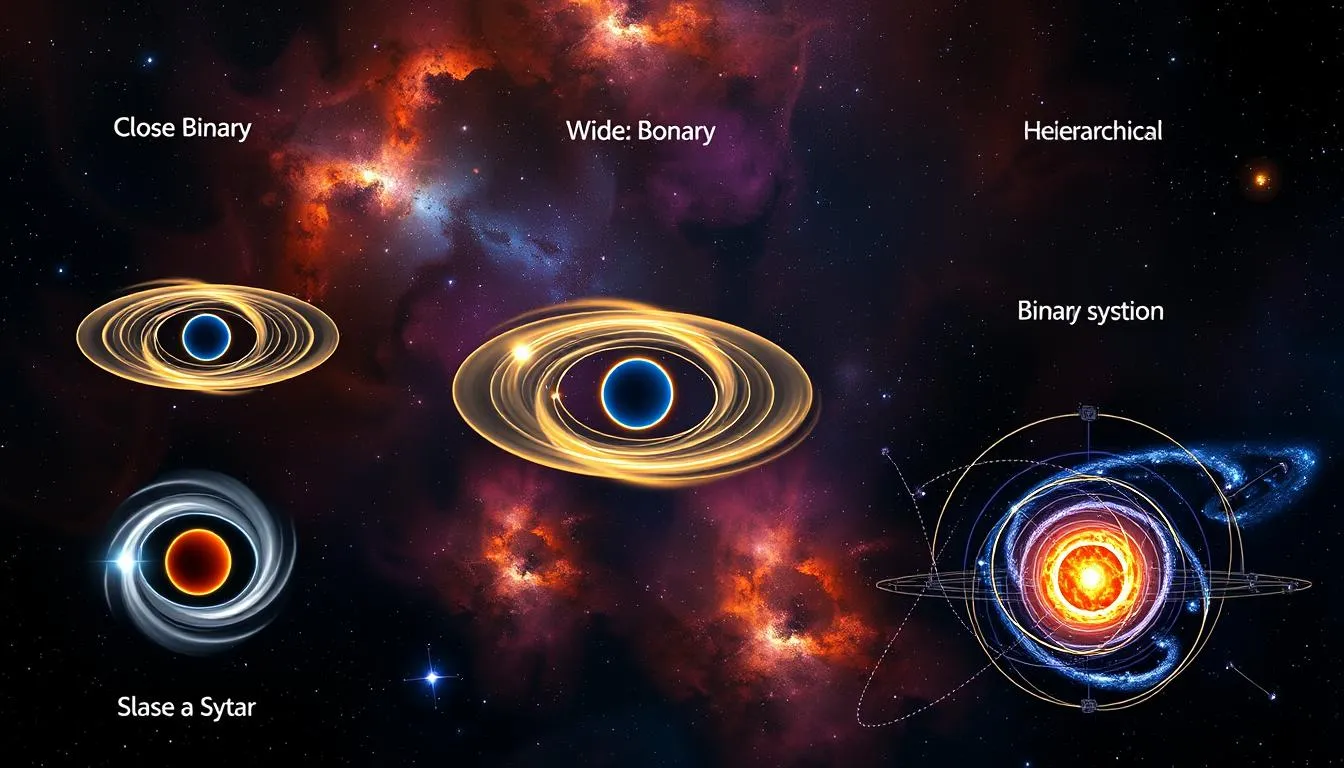
Binary Star System – Definition, Types, Examples & Importance for UPSC

Binary Star Systems – Meaning, Types, Importance in Astronomy (Complete Guide for UPSC)
Introduction
When we look at the night sky, we think every shining object is a single star.
But in reality, more than half of the stars in our universe live in pairs. These pairs are called Binary Star Systems.
Just like two friends who always stay together, a binary star system has two stars orbiting around a common center because of gravity.
In UPSC, this topic appears under Space Science, Universe, and Astronomy in both Prelims & GS Paper-1.
What is a Binary Star System? (Simple Definition)
A binary star system is a system where two stars orbit each other because of mutual gravitational attraction.
They don’t collide because they maintain a controlled balance—similar to how the Earth and Moon move around each other.
Key Points
-
Two stars together = binary system
-
They orbit around a point called common center of mass
-
Very common in our galaxy
-
Helps scientists understand star mass, evolution, and distances
Why Do Binary Stars Matter in Astronomy?
Binary stars are extremely important because:
-
They help measure the mass of stars
(The most accurate way to calculate stellar mass) -
They help study how stars evolve
From birth → mid-life → death -
This makes the topic scientifically important and relevant for UPSC aspirants.
-
They help detect black holes
When one star disappears but its gravity is felt -
They help understand supernovas
Special type: Type-Ia supernova occurs due to binary stars -
They help calculate distance of far-away stars
Types of Binary Star Systems
Scientists classify binary stars based on how we observe them.
There are four major types:
1. Visual Binary
-
You can see both stars separately through a telescope.
-
Both appear distinct.
-
Example: Sirius A and Sirius B (the brightest star pair seen from Earth)
2. Spectroscopic Binary
-
The stars are so close that we cannot see them separately.
-
Their presence is known by analyzing light wavelengths (spectra).
-
Used to measure: star velocity and mass.
3. Eclipsing Binary
-
One star passes in front of the other creating an eclipse.
-
Brightness of the system dips regularly.
-
4. Astrometric Binary
-
Only one star is visible.
-
But it behaves strangely (wobbles), showing that an invisible partner is pulling it.
-
Often used to detect:
-
Brown dwarfs
-
Black holes
-
Famous Example: Algol system
This method is very important for discovering exoplanets too (transit method).
How Binary Stars Are Detected?
Astronomers use different tools to find binary systems:
✔ Telescopes (direct viewing)
Used for visual binaries.
✔ Spectroscopy (light analysis)
Checks Doppler shifts — used for spectroscopic binaries.
✔ Light-curve observation
Used for eclipsing binaries.
✔ Astrometric wobble measurement
Used for astrometric binaries.
These detection methods are important for Prelims and Science & Tech mains answers.
Examples of Famous Binary Star Systems
Binary Star Type Special Feature Sirius A & B Visual Brightest binary seen from Earth Alpha Centauri Triple system Nearest star system to Earth Algol Eclipsing Periodic dimming Cygnus X-1 X-ray binary Contains a black hole
Role of Gravity in Binary Stars
Gravity binds the two stars and decides:
-
Their orbital speed
-
Distance between them
-
Orbit shape (circular or elliptical)
-
The point they revolve around is called the Barycenter (common center of mass).
Do Binary Stars Affect Planets?
Yes, planets can exist in binary systems.
Two types of orbits are possible: -
S-type orbit: Planet orbits only one star.
-
P-type orbit: Planet orbits both stars together (circumbinary planets).
-
Movies like Star Wars (Tatooine) show sunsets with two suns — inspired by binary star systems.
Importance of Binary Stars in UPSC
UPSC frequently asks about:
-
Star formation
-
Stellar evolution
-
Light years, parallax, luminosity
-
Supernova types
-
Black holes and X-ray binaries
-
Binary stars directly help understand all these.
Example UPSC-style question:
“What are binary star systems? Explain their role in determining stellar masses.”
Conclusion
Binary star systems are extremely common and scientifically valuable.
They consist of two stars orbiting each other, helping astronomers measure mass, distance, evolution, and detect hidden celestial objects like black holes.For UPSC aspirants, this topic strengthens conceptual clarity in astronomy, science & tech, and universe-related questions.
Also Read This - Best IAS Coaching in Delhi with Experienced Faculty
0 Comments
No comments yet. Be the first to comment!
Reply to this Post
Newsletter
Letest Posts


Basic Guide to Start Preparation for IAS & IPS
UPSC | 1 months ago
CSAT Preparation Time Table for UPSC 2026 – 30 / 60 / 90 Day Plan
UPSC | 1 months ago
How to Clear CSAT in First Attempt
UPSC | 1 months ago