Lodhi Samaj Scholarship Test Result Out 2026

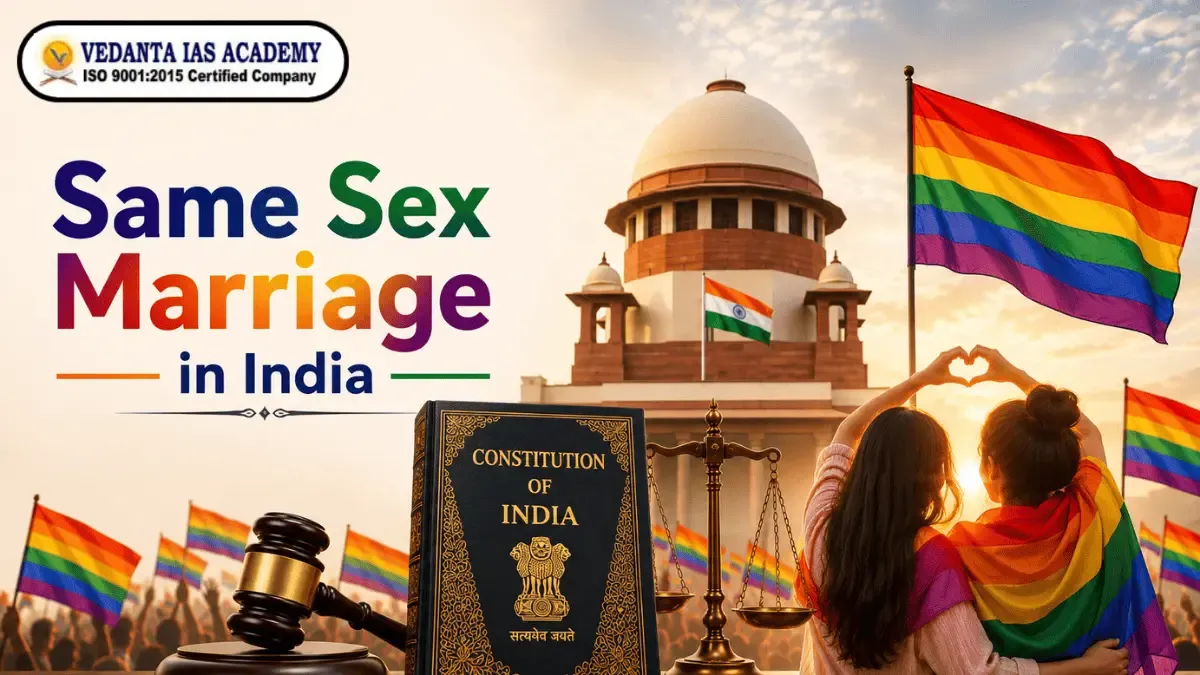

Same sex marriage is one of the most talked about topics in India today. It brings together questions of law, human rights, religion, culture, and identity all at once. For students preparing for UPSC, law exams, or anyone who wants to understand this issue deeply, this article covers everything.
We'll look at what same sex marriage is, how the debate started in India, what the Supreme Court said, and what the future looks like. Let's understand this step by step.
Same sex marriage is a marriage between two people of the same sex (between two women or two men). As with every other marriage, it entails the legal rights to reside with one another, share property, inherit, adopt children, and obtain all the rights of marriage granted by law. Same sex marriage is legal in many countries. However, it is not recognised under the law in India.
In India, marriage is currently regulated by personal laws, such as the Hindu Marriage Act, Muslim Personal Law, Special Marriage Act, and others. Currently, none of these laws include or recognise gay marriage.
Why LGBTQ couples in India have serious legal challenges even when in a serious relationship – because they have none of the privileges or legal recognition as a couple.
The debate around same sex marriage in India didn't start suddenly. It has a long history going back decades.
For a very long time, same sex relationships were criminalised in India under Section 377 of the Indian Penal Code. This colonial-era law punished "unnatural offences" and was used against LGBTQ+ individuals. It made any open discussion or fight for rights extremely difficult.
In Naz Foundation vs Government of NCT of Delhi (2009), the Delhi High Court gave a landmark judgment. It read down Section 377 and said that consensual same sex relationships between adults should not be treated as a crime. This was a historic moment.
But in Suresh Kumar Koushal vs Naz Foundation (2013), the Supreme Court reversed the Delhi High Court judgment. It re-criminalised same sex relationships and said that changing Section 377 was a job for Parliament, not the courts. This was a big setback for the LGBTQ+ community.
The real turning point came in Navtej Singh Johar vs Union of India (2018). A five-judge Constitution Bench of the Supreme Court unanimously struck down Section 377 as unconstitutional. The court said LGBTQ+ individuals have the same rights as every other citizen — the right to dignity, equality, and freedom.
This judgment decriminalised homosexuality in India. But it did not legalise same sex marriage. That debate came next.
In October 2023, a five-judge Constitution Bench of the Supreme Court heard petitions asking for legal recognition of same sex marriage in India. The case is Supriyo Chakraborty vs Union of India (2023). The court gave its verdict — by a 3-2 majority, it refused to legalise same sex marriage. We'll talk about this in detail further in this article.
As of today, same sex marriage is not legal in India.
In India there is no law that permits marriage between two individuals of the same sex, be it the Hindu Marriage Act, the Muslim Personal Law, the Christian Marriage Act or the Special Marriage Act.
The petitioners in the 2023 Supreme Court case specifically asked the court to either:
The Supreme Court rejected both requests.
However, the court did acknowledge some important things:
The court said that only Parliament can make or amend laws regarding marriages, and the judiciary will not come into the picture. It requested Parliament and the Government to consider granting some rights to same sex couples even if not marriage.
So right now, same sex couples in India have:
This is a very important question. The Supreme Court of India is known for expanding rights. Then why did it not legalise same sex marriage?
The 3-2 majority judgment gave several reasons:
1. No Fundamental Right to Marry
The court stated that there is no fundamental right of marriage in the Indian constitution. Marriage is not a constitutional right, but a social and legal construct, established by law. So no court can "make" it for any group.
2. Parliament Must Decide
India is a democratic country. Parliament is the voice of the people. But a change that is profound, of redefining marriage, is not something to be handed down by judges, it must be decided by elected officials. It is not the role of the court to make laws, it said.
3. Personal Laws Are Complex
There are several personal laws in India that are based on religion and community. All of them - Hindu law, Muslim law, Christian law and more - would be impacted by changing the definition of marriage. Careful and detailed legislation is needed, and only Parliament can provide it.
4. Majority vs Minority Opinion
Among the five, two judges, Justice S.K. Kaul and Justice S.R. Bhat (partially) had more progressive views. The court erred in failing to go further in safeguarding rights, Justice Kaul said. However, most resisted.
5. Government's Position
Union Government was very much against legalisation of same sex marriage. It stated that marriage is a "social institution", established by centuries of tradition and law, and it should be between man and woman.
While many people support LGBTQ+ rights, there are also arguments made against legalising same sex marriage in India. Understanding both sides is important for a balanced view.
1. Religious and Cultural Arguments
Many religious groups - Hindu, Muslim, Christian, and others - believe marriage is a sacred bond between a man and a woman. They argue that changing this definition goes against religious texts and centuries of tradition.
2. Impact on Children
Others state that kids will be better off in families that have two parents, one male and one female. There is a fear that child development would be negatively impacted by the legalisation of same-sex marriage and adoption by same-sex couples - although numerous studies in other countries have found no adverse effects.
3. Societal Readiness
India is a diverse country, and there are millions of people in India who have traditional values. A lot of people say that Indian society is not ready for such a significant change and that the imposition of such change by the courts instead of general consensus would bring division.
4. Parliamentary Process
Some legal experts argue that this change must come through democratic debate and legislation not a court order. They say the judiciary should not overstep into law-making territory.
It is important to note that holding these views is different from discriminating against or harming LGBTQ+ individuals. The debate is about legal recognition of marriage not about denying people their basic dignity.
Even though same sex marriage is not legal, LGBTQ+ couples in India exist and face real challenges every day.
Legal Challenges
Social Challenges
What Rights Do They Have?
After the 2018 Navtej Singh Johar judgment, LGBTQ+ individuals have:
The Supreme Court in 2023 also directed the government to form a committee to look into rights that can be given to same sex couples like joint bank accounts, nomination rights, and insurance benefits without calling it marriage.
What happens next? Will same sex marriage ever be legal in India?
1. The Bill Is in Parliament's Court
The Supreme Court was very clear, Parliament must take action. Now it comes down to elected legislators to present a bill or a policy that either legalises same sex marriage or provides legal recognition to same sex relationships in some way.
Currently, there has been no major political party in India to officially rally behind same sex marriage. It has been opposed by the ruling party. The opposition parties are mostly silent on the matter.
2. State-Level Changes
Some experts think that change might occur first at a state level and that certain progressive state governments recognise same sex relationships or give some rights to them. This might gradually establish a nationwide consensus.
3. Public Opinion is Shifting
Younger Indians are more accepting of LGBTQ+ rights than their elders, with the latter showing a stronger support for the issue in urban areas than their rural counterparts. Attitudes in Parliament may change as this generation grows and becomes politically influential.
4. International Pressure
More than 35 countries, such as United States, Canada, France, Germany, Australia, and South Africa, have legalized same sex marriage. The international context is important particularly in the context of India's image as a rights-respecting country in the era of its emergence as a global democracy.
5. Legal Route Still Open
The Supreme Court's 2023 verdict was not the final word. Petitioners can approach the court again with new arguments. And if Parliament fails to act, future benches may take a more expansive view of fundamental rights.
The fight for LGBTQ+ rights in India has been long, brave, and full of setbacks and victories.
Key Milestones:
Key Organisations Working for LGBTQ+ Rights in India:
These organisations offer legal assistance, mental health services, safe spaces and advocacy services for LGBTQ+ people in India.
The Indian pride movement has been exponentially expanded in the last 20 years. Thousands march in annual pride marches in cities now, including Delhi, Mumbai, Chennai, Bengaluru, Hyderabad and Kolkata.
Same sex marriage in India remains an important legal, constitutional, and social issue. The debate involves equality, law, democratic values, and human dignity. While same sex marriage is not currently legal in India, discussions around rights, recognition, and legal reform continue. Understanding this topic helps readers better understand modern constitutional debates and the changing conversation around LGBTQ+ rights in India.
Q1. Is same sex marriage legal in India?
No. At present, same sex marriage is not legally recognized in India.
Q2. What did the Supreme Court say about same sex marriage in India?
The Supreme Court did not legalize same sex marriage and said major changes in marriage law should come mainly through Parliament.
Q3. Which constitutional articles are linked to same sex marriage?
The debate often involves Article 14 (Equality), Article 15 (Non-discrimination), and Article 21 (Right to Life and Personal Liberty).
Q4. Can same sex couples adopt children in India?
Adoption rights remain legally complex and depend on existing laws and regulations.
Q5. What is the future of same sex marriage in India?
The future debate may continue through legal discussion, legislative action, and changing social views
No comments yet. Be the first to comment!