
The Civil Services Aptitude Test (CSAT) is Paper 2 of the UPSC Prelims exam. Many beginners ask What is CSAT Exam in UPSC? It is a qualifying paper that tests basic skills like comprehension, reasoning, and simple maths. Only a qualifying paper, CSAT is yet the most important. In case you fail CSAT, you will not have your marks in General Studies (GS) Paper 1 counted at all.
CSAT is aimed at examining your fundamental abilities, such as problem solving, reading comprehension and logic. This is the reason why all students ought to get ready for it despite the fact that they might not have a math background.
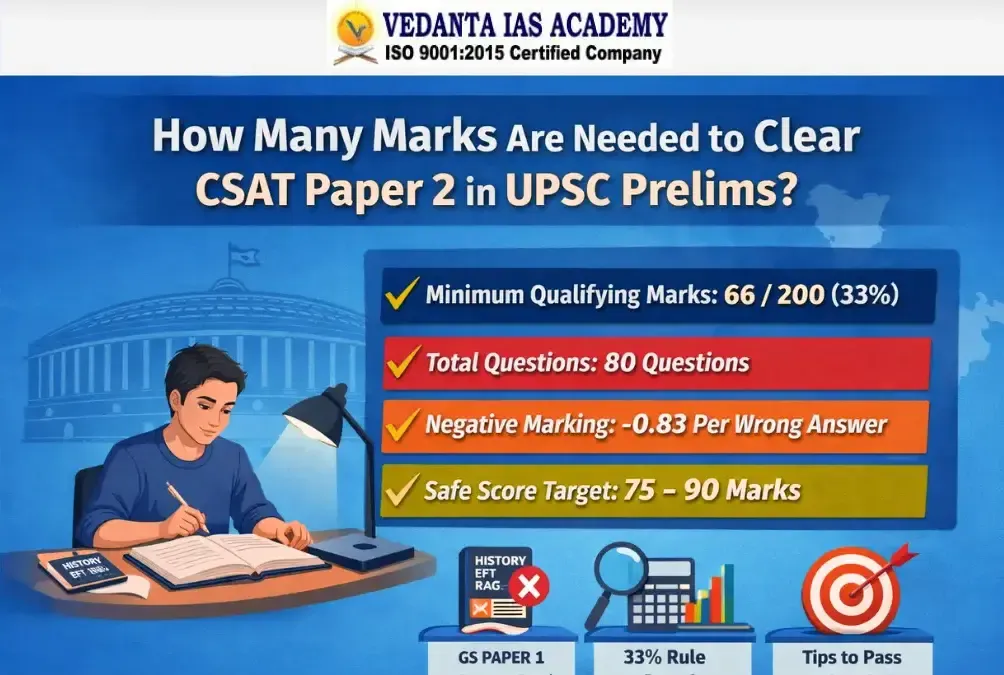
The CSAT qualifying marks UPSC has fixed is 33%. This means you need to score at least 33% of the total marks in CSAT Paper 2 to pass.
The total marks of CSAT Paper 2 are 200. So, the minimum score needed to qualify CSAT is:
This is also called the UPSC CSAT passing marks. If you score 66 or more, you qualify for the CSAT. If you score even 65, you fail, and your GS Paper 1 will not be checked.
So, always remember:
You must score at least 66 marks in CSAT to clear it.
The 33% rule is simple but very strict. It means:
CSAT is perceived by many students to be easy. The level of difficulty has however grown within the past years. Due to this reason, a good number of candidates do not secure the UPSC CSAT passing marks.
This rule is therefore very important to comprehend. You should not aim at being just 66 marks, but a safe score beyond that.
To understand how to score well, you must know the pattern of CSAT.
Basic Exam Pattern:
Marks Distribution:
Subjects Covered:
According to UPSC CSAT Syllabus 2026, the paper includes:
This is why it is important to understand how CSAT marks are calculated. Correct answers increase your score, but wrong answers reduce it. So, accuracy matters a lot.
In earlier years, CSAT was considered easy. Many candidates cleared it without much preparation. But in recent years, the difficulty level has changed.
Key Trends:
Due to this, many aspirants fail to achieve the CSAT qualifying marks UPSC requires. This shows that CSAT is no longer an easy paper.
So, you should not ignore it. Proper preparation is required, especially for beginners.
CSAT plays a very important role in your final Prelims result.
Important Points:
If you fail to get the minimum score needed to qualify CSAT, then:
This is why many candidates who score high in GS still fail the exam because they do not clear CSAT.
Also, note that UPSC CSAT cutoff marks do not exist like GS Paper 1. Only the 33% rule applies.
Even though 66 marks is the minimum, you should aim higher to stay safe.
Recommended Safe Score:
Why aim higher?
Because:
So, instead of aiming just to pass, try to score comfortably above the cutoff.
Now the question is: how many questions should you attempt?
Smart Attempt Strategy:
Let’s understand with an example:
Your score:
This is just above the qualifying marks.
So, your goal should be:
Attempt fewer questions but with high accuracy
This is a key part of CSAT preparation strategy for beginners.
Many students feel nervous about CSAT, especially those from humanities backgrounds. But with the right plan, you can clear it easily.
Simple Strategy:
Tips:
If you follow these steps, you can even learn how to clear CSAT in first attempt.
To clear CSAT Paper 2, you need at least 66 marks, which is 33% of the total. This is the UPSC CSAT passing marks. But aiming just for 66 is risky.
A better approach is:
CSAT qualifying paper,, but it is very important. Many candidates fail every year because they ignore it.
That is why you need to be smart, have a plan, and be sure to pass the lower limit of the score required to graduate CSAT with ease.
Clearing CSAT is a simple step to be taken with preparation, consistency, and practice so that you can be a step closer to the UPSC dream.
No comments yet. Be the first to comment!