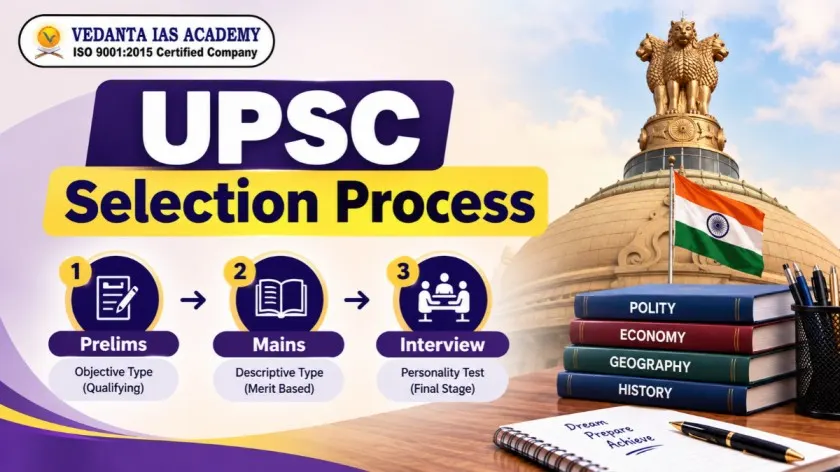
The UPSC Civil Services Examination process of selection is a three-step process – Preliminary Examination, Main Examination and Personality Test (Interview). The Prelims is conducted to filter out candidates for Mains. The final merit list will be prepared based on the marks obtained in the written examination (mains) and on the personality test.
The candidates who meet the final merit criteria are placed in the rank list and are considered for services like Indian Administrative Service (IAS), Indian Police Service (IPS), Indian Foreign Service (IFS) and others on the basis of their rank, preference and rules.
Application → Preliminary Examination → Main Examination → Personality Test → Final Merit List → Service Allocation
UPSC Selection Process 2027 Overview
The UPSC selection process for 2027 will follow the Civil Services Examination framework prescribed by the Commission for that examination year. The selection process can be understood in three major examination stages:
- Prelims Examination
- Main Examination
- Personality Test (Interview)
After these stages, UPSC prepares the final merit list based on the marks counted for ranking. Candidates are then considered for different services according to their rank, preferences and applicable government rules.
1-Stage Of UPSC Selection Process: Preliminary Examination
The first stage of the UPSC CSE Prelims exam.
It serves mainly as a screening test to choose applicants for the final exam. According to the UPSC examination scheme, applicants who are qualified for Mains do not have their Prelim scores taken into account while calculating their ultimate order of merit.
There are two objective-type papers in the preliminary exam:
- General Studies Paper 1
- Civil Services Aptitude Test (CSAT)
The minimum qualifying requirement for General Studies Paper I under the published UPSC scheme is 33%. CSAT is qualifying in nature.
Do Prelims Marks Count in Final Selection?
No. UPSC Prelims marks are used for screening candidates for the Main Examination and are not added to the marks used for the final order of merit.
This is an important point for beginners. A candidate may score very well in prelims, but those marks do not directly increase the final rank. The prelims result determines whether the candidate can move to the next stage.
2-Stage Of UPSC Selection Process: Main Examination
The UPSC Main Examination is the second major stage of the civil services selection process.
Unlike the prelims, the Mains written examination uses conventional written-answer papers. The UPSC examination scheme provides for nine written papers, of which two are qualifying in nature, while the prescribed competitive papers contribute to ranking.
|
Paper |
Marks |
|
Paper A – Indian language |
300 Marks (Qualifying Papers) |
|
Paper B - English |
300 Marks (Qualifying Papers) |
|
Essay |
250 Marks |
|
GS Paper 1 |
250 Marks |
|
GS Paper 2 |
250 Marks |
|
GS Paper 3 |
250 Marks |
|
GS Paper 4 |
250 Marks |
|
Optional Paper 1 |
250 Marks |
|
Optional Paper 2 |
250 Marks |
|
Total Marks |
1750 Marks |
Last Stage of UPSC Selection Process: Interview
The UPSC interview is the last stage of the UPSC CSE selection process.
It is not simply a test of how much factual information a candidate can remember. The personality test is designed to assess the candidate's suitability for a career in public service and the qualities relevant to such service.
The personality test carries 275 marks under the published civil services examination scheme, with no separate minimum qualifying marks specified for the test in that scheme.
Candidates may be asked about their educational background, interests, current affairs, academic subjects, work experience and issues connected with their Detailed Application Form (DAF), along with broader questions intended to understand their thinking and personality.
UPSC Documents Verification & Medical Exam
After the UPSC Personality Test, candidates may need to complete document verification and medical examination as part of the selection and appointment process. Candidates must provide valid documents such as proof of age, educational qualifications, category certificates, and other documents required by UPSC.
Medical examination and physical standards may vary depending on the service. Candidates should check the latest UPSC notification and applicable service rules for the exact requirements.
For UPSC CSE 2027, always verify the latest document and medical requirements from the official UPSC notification before proceeding. Check first: https://www.upsc.gov.in/
Frequently Asked Questions
Q1. How many stages are there in the UPSC selection process?
Ans. The UPSC selection process involves three major stages – Prelims, Mains and Personality Test (Interview) – and finally merit and service allocation.
Q2. Is UPSC Prelims only a qualifying examination?
Ans. Yes. Prelims is a screening stage, and its marks are not counted in the final merit list.
Q3. Do preliminary marks count in final selection?
Ans. No. The marks obtained in prelims are not added to the final merit.
Q4. How are candidates selected for UPSC Mains?
Ans. Candidates are selected on the basis of the performance in the prelims and the qualifying criteria set by UPSC.
Q5. How are candidates selected for the UPSC interview?
Ans. Candidates who satisfy the main written-stage standard are invited to the personality test.
Q6. How is the final UPSC merit list prepared?
Ans. The final merit will be based on the marks obtained in the mains, counted for ranking, and the marks obtained in the personality test.
Q7. Does the UPSC interview affect the final rank?
Ans. Yes. Marks of the personality test are added in the final merit calculation.
Q8. How are IAS and IPS candidates selected?
Ans. The allocation of services is primarily based on the final rank, preference of services, number of vacancies and applicable rules.